


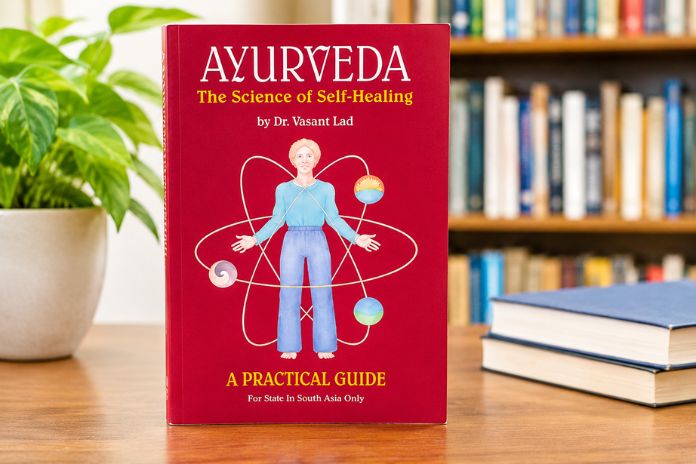
by Dr. Vasant Lad (Author)
Vasant Lad – Ayurveda: The Science of Self-Healing – A Practical Guide to Understanding Traditional Indian Medicine
One of the well known introductory works on Ayurvedic medicine. Discusses the principles of Ayurveda, individual constitution, diagnosis, diet, medicinal herbs and comprehensive approaches to health.
Rediscovering Ayurveda The Science of Self-Care
As the focus of health discussions is shifting more toward preventive care, personalised wellness and the relationship between lifestyle and wellness, Ayurveda provides a traditional perspective on health beyond just disease management. It highlights the necessity of balancing the body, mind and environment and offers an important perspective on holistic health.
One book that has helped introduce readers in various countries to these principles is Ayurveda: The Science of Self-Healing – A Practical Guide, by renowned Ayurvedic physician and educator Dr Vasant Lad.
First published in 1984, the book is an easy-to-understand introduction to Ayurveda with its philosophical basis and practical concepts of health, diagnosis, diet, medicinal plants and daily self-care. It introduces readers to the larger principles that underlie this ancient Indian system of medicine, rather than viewing Ayurveda as just a collection of remedies.
The Book and Its Main Theme Explained
The book aims to explain the basic principles and practical applications of Ayurveda in a manner that is accessible to the layman with little knowledge of medicine or philosophy.
“In Ayurveda, health is viewed as the relationship between an individual’s constitution, physiological functioning, lifestyle, diet and the surrounding environment. The book starts this perspective by explaining foundational Ayurvedic ideas and their relevance to health maintenance.
A crucial element of its approach is the theory-practice relationship. Readers are exposed to the philosophy of Ayurveda as well as practical topics such as dietary choices, medicinal kitchen herbs, diagnostic techniques and traditional treatment approaches.
The book is thus an introductory guide for those who wish to understand how Ayurveda conceptualises health, disease prevention and individualised care.
Diving Into Big Ideas and Fields of Knowledge
1. Ayurveda – History and Philosophy
The book starts with a discussion of historical and philosophical foundations of Ayurveda. It examines Ayurveda as a traditional system of knowledge linking health to broader understandings of life, nature and the human condition.
This background is important because Ayurvedic practices are based on an interconnected understanding of the individual and not an isolated consideration of symptoms.
The philosophical discussion provides readers with a basis for comprehending the principles that support Ayurvedic approaches to diagnosis, treatment, and lifestyle.
2. Basic principles and personal constitution
The knowledge of three doshas Vata, Pitta and Kapha is one of the most important areas of Ayurvedic knowledge.
These principles are used in Ayurveda to explain various patterns of physiological and functional characteristics. All of their proportions add up to the idea of Prakriti, or an individual’s constitutional nature.
The book begins with these basic ideas and their importance for the understanding of individual differences.
This offers an introduction to the system’s focus on personalised approaches to diet, daily routines and health management for readers new to Ayurveda.
3. Ayurvedic Diagnostic Methods
Another major topic in the book is diagnosis.
In traditional Ayurveda, numerous facets of a person’s condition were evaluated, such as physical features, digestive processes, and other visible indications. Pulse examination, tongue observation, and other techniques are part of Ayurveda’s rich diagnostic tradition.
This discussion familiarises readers with the traditional view of assessment and the importance of looking at the whole picture of the person and not just one complaint.
4. Nutrition, diet and medicinal herbs
Diet is an important aspect of Ayurvedic health management. Examines the relationship between food, digestion and personal constitution.
It also provides an introduction to the medicinal uses of common kitchen herbs and spices and their role in traditional Ayurvedic practice.
This section is of particular interest to those interested in the relation between everyday food choices and traditional approaches to health maintenance.
Ayurvedic principles are more accessible when practical information about herbs and dietary considerations is connected to familiar aspects of everyday life. However, traditional uses are not to be taken as proof of clinical effectiveness or as a substitute for professional medical advice.
5. Treatment, First Aid, and Practical Use
The book discusses foundational theory as well as traditional treatment approaches and practical applications related to health.
The inclusion of first aid, food antidotes and other everyday considerations shows the author’s desire to make Ayurvedic knowledge accessible beyond academic discussion.
Over 50 charts, diagrams and tables are also used in the book for visual illustration of concepts. A glossary and index also help readers to understand specialist terminology and find relevant information.
Author and His Contribution to Ayurveda
Dr Vasant Dattatray Lad is an Indian Ayurvedic doctor, teacher and internationally known writer whose work has been crucial to introducing Ayurveda to people outside India.
He has a degree of Bachelor of Ayurvedic Medicine and Surgery (BAMS) from University of Pune and Master of Ayurvedic Science (MASc) from Tilak Ayurved Mahavidyalaya, Pune. He has 3 years of experience as Medical Director at Ayurveda Hospital, Pune and 15 years as Professor of Clinical Medicine at Pune University College of Ayurvedic Medicine.
In 1984 he opened The Ayurvedic Institute in the United States, from which Ayurveda could be studied systematically.
His contribution goes beyond this particular publication. Dr Lad has conveyed the classical concepts of Ayurveda to international students, practitioners and general readers through books, education programs, lectures and clinical teaching.
His background in education and experience in both traditional Ayurveda and Western medicine provide an important context for understanding his approach to presenting Ayurvedic knowledge in an accessible and practical format.
Importance and Relevance for Today’s Reader
The continuing relevance of The Science of Self-Healing (Ayurveda) lies in its attempt to make the core principles of Ayurveda understandable and applicable to everyday life.
For students and practitioners of Ayurveda: A basic introduction to the basic concepts such as doshas, constitution, diagnostic approaches, diet and traditional therapeutic principles. It can be used as an additional reading for students who are beginning their journey into Ayurvedic philosophy and practice.
For health care professionals: It offers a chance to understand the conceptual framework of Ayurveda through the presentation of traditional approaches regarding individual constitution, diet considerations, and lifestyle. It can also facilitate informed interdisciplinary discussions on traditional medicine systems.
For Researchers & Academics: The book serves as a reader-friendly introduction to some of the basic fields of Ayurvedic knowledge. This, together with the classical texts and the current scientific literature, will be needed for those readers who want to delve deeper into the academic analysis or evidence-based evaluation of specific Ayurvedic interventions.
For general readers: It is a good starting point for those interested in learning about India’s traditional system of medicine because of its clear presentation of Ayurveda, supported with diagrams, charts and explanations of everyday herbs and dietary practices.
An Editorial Perspective: Power and Range
One of the book’s main strengths is its effort to connect Ayurvedic philosophy with practical knowledge. Dr Lad does not present Ayurveda as a mere abstract philosophical system, but introduces topics that readers can relate to their daily life such as food, digestion, individual constitution and traditional health practices.
Another useful element is the visual presentation. There are over 50 charts, diagrams, and tables within the book to help organise complex ideas and make the material more accessible to beginners. The glossary and index also contribute to its utility as a reference-oriented introductory text.
Its comprehensive coverage of topics ranging from history and philosophy to diagnostic techniques, diet, medicinal herbs and first aid, give the readers a basic idea of the various dimensions of Ayurveda.
At the same time, the book needs to be read with awareness of its scope and historical context. It is an introductory work, not a current clinical practice guideline or a systematic review of scientific evidence, and it was first published in 1984. Its canonical accounts of diagnostic and therapeutic procedures are not to be taken literally as established biomedical facts.
If you are a reader interested in the clinical application, we recommend that you supplement your understanding with current professional guidance, appropriate scientific research and qualified healthcare advice. It is not advisable to treat serious medical conditions by yourself or to replace prescribed treatment with traditional remedies.
These considerations do not diminish the value of the book as an introduction to Ayurvedic thought. Instead, they help to place it properly within the framework of current health education.
Conclusion: An Introduction to the Basics of Ayurveda for Laypersons
Dr Vasant Lad’s Ayurveda: The Science of Self-Healing – A Practical Guide is a pertinent introductory material for readers who want to be acquainted with the basic concepts and practical aspects of Ayurveda.
Its strength is that it combines philosophical foundations, individual constitution, diagnostic approaches, dietary principles and traditional medicinal knowledge in an accessible format. The author brings extensive experience as an Ayurvedic physician and educator to this presentation.
The book offers a useful foundation for students starting a study of Ayurveda, healthcare professionals who would like to familiarise



