


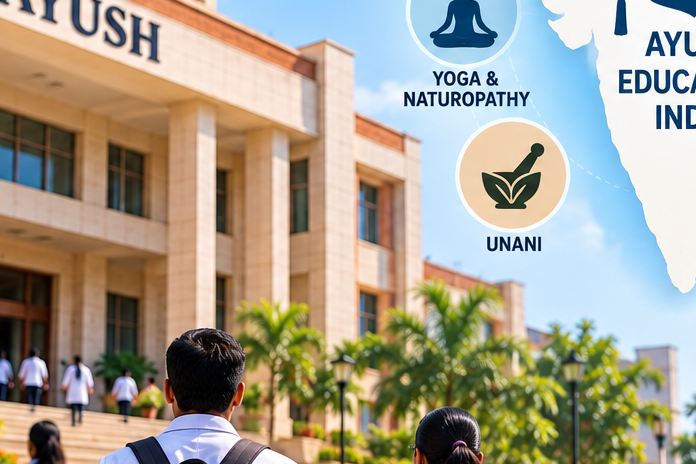
India’s AYUSH education sector has expanded to 971 colleges offering undergraduate and postgraduate programmes, with a combined admission capacity of 79,593 students as of 1 April 2024. However, non-government institutions account for the majority of these colleges, highlighting the significant role of private educational institutions in the country’s traditional medicine education system.
The figures were reported in The Hindu in an article titled “AYUSH education expands in country, but non-government colleges dominate”. Further details are available in the Ministry of Ayush publication Ayush in India 2024, which provides statistics on the expansion and distribution of AYUSH educational institutions across the country.
Growth of AYUSH Education in India
AYUSH is an umbrella term covering Ayurveda, Yoga and Naturopathy, Unani, Siddha, Sowa-Rigpa and Homoeopathy.
According to Ayush in India 2024, India had 971 AYUSH colleges with a combined admission capacity of 79,593 students as of 1 April 2024. These institutions offered undergraduate and postgraduate programmes.
Of the total institutions, 960 colleges offered undergraduate courses, with an admission capacity of 71,606 students. The remaining institutions provided postgraduate education.
The figures indicate the growing institutional presence of AYUSH education in India. They also highlight the importance of educational infrastructure, faculty development and regulatory oversight as the sector expands.
Ayurveda Accounts for the Largest Share of AYUSH Colleges
Among the different AYUSH systems, Ayurveda has the largest number of educational institutions.
According to the Ministry of Ayush report, the institutional distribution of Ayurveda colleges as of 1 April 2024 was:
- Total Ayurveda colleges: 541
- Government colleges: 74
- Private colleges: 467
- Total admission capacity: 45,061 students
- Permitted seats: 41,816
Non-government institutions account for approximately 86.3% of Ayurveda colleges, while government institutions represent around 13.7%.
The difference between admission capacity and permitted seats is also important. Admission capacity refers to the reported capacity of institutions, whereas permitted seats refer to the number of seats approved under the applicable regulatory framework.
These figures demonstrate the significant role of private and other non-government institutions in providing access to Ayurveda education across the country.
Non-Government Institutions Also Dominate Other AYUSH Systems
The predominance of non-government institutions is not limited to Ayurveda. The Ministry’s report also provides institutional statistics for other AYUSH systems.
The distribution as of 1 April 2024 is summarised below:
| AYUSH system | Total colleges | Government colleges | Private/non-government colleges | Admission capacity |
|---|---|---|---|---|
| Unani | 58 | 16 | 42 | 3,766 |
| Siddha | 17 | 3 | 14 | 1,307 |
| Yoga and Naturopathy | 71 | 15 | 56 | 5,358 |
| Homoeopathy | 277 | 41 | 236 | 24,001 |
| Sowa-Rigpa | 7 | 3 | 4 | 100 |
The figures show that non-government institutions account for a substantial share of educational infrastructure across several AYUSH disciplines.
Importance of Regulatory Oversight
The growing number of non-government colleges makes effective regulation and quality assurance particularly important.
Students considering admission to AYUSH courses should verify institutional recognition, permitted intake, faculty availability, infrastructure and academic standards before selecting a college.
The National Commission for Indian System of Medicine (NCISM) has statutory responsibilities relating to the regulation of education and professional standards in Indian systems of medicine. The National Commission for Homoeopathy (NCH) is the corresponding regulatory body for Homoeopathy.
The presence of a college does not necessarily mean that every course or advertised seat is authorised for a particular academic year. Students should therefore verify the latest official permission and recognition details before applying.
What the Expansion Means for Students and the Healthcare Sector
The expansion of AYUSH educational institutions may create additional opportunities for students interested in traditional systems of medicine.
A wider institutional network can contribute to teaching capacity, postgraduate education and the future availability of qualified professionals. It may also create opportunities for academic research and institutional collaboration.
However, the number of colleges alone does not determine the quality of education.
The preparation of competent healthcare professionals also depends on:
- Availability of qualified teaching faculty.
- Well-equipped laboratories and libraries.
- Adequate clinical training facilities.
- Research infrastructure.
- Sufficient patient exposure and practical learning opportunities.
The growing presence of non-government colleges also highlights the need for regulators and policymakers to maintain consistent academic standards across institutions.
Points to Consider Before Choosing an AYUSH College
Students and parents considering AYUSH education should check the following before selecting an institution:
- College approval: Verify whether the college has the required approval for the relevant academic year.
- Programme recognition: Check whether the specific undergraduate or postgraduate programme is recognised.
- Permitted intake: Confirm the number of officially approved seats rather than relying only on advertised admission capacity.
- Faculty and infrastructure: Review the availability of qualified faculty, laboratories, libraries and clinical training facilities.
- Admission process: Follow official admission and counselling notifications for eligibility requirements, entrance examinations and deadlines.
The latest information should be obtained from the relevant statutory regulator and official counselling authorities.
Why This Matters for India’s AYUSH Sector
The expansion of AYUSH education represents an important development in India’s traditional medicine education system. Hundreds of institutions now operate across different AYUSH disciplines, and educational capacity is no longer confined to government-run colleges.
At the same time, the predominance of non-government institutions raises important questions about accessibility, affordability, academic consistency and regulatory compliance.
The long-term development of AYUSH education will depend not only on increasing the number of institutions but also on strengthening teaching quality, research capabilities, clinical training and institutional accountability.
Conclusion
India’s AYUSH education network had 971 colleges and a combined admission capacity of 79,593 students, according to the Ministry of Ayush publication Ayush in India 2024. The figures also show that non-government institutions dominate the educational landscape. In Ayurveda alone, 467 of the 541 colleges were classified as private institutions.
The data highlights the need to balance educational expansion with quality assurance and effective regulation. For students, institutions and policymakers, ensuring that growth is supported by recognised programmes, qualified faculty and adequate academic infrastructure will remain essential to the future of AYUSH education in India.
Source: Ministry of Ayush, Ayush in India 2024, Section 4: Medical Education. Additional news coverage: The Hindu, “AYUSH education expands in country, but non-government colleges dominate”.



