


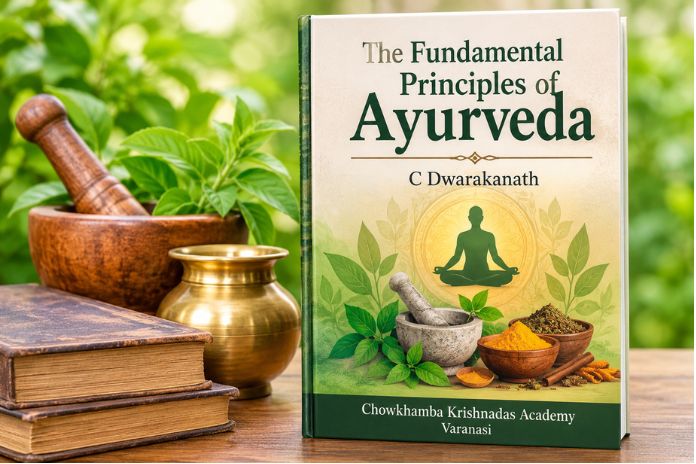
The Basic Principles of Ayurveda: An Academic Study of the Basis of Ayurvedic Knowledge by Prof. C. Dwarakanath
This is a significant academic work that relates classical Ayurvedic concepts with the Indian philosophical traditions. It provides students and scholars with greater insight into Padartha Vijnana, the roots of Ayurveda and the intellectual framework that underlies this traditional system of medicine.
Introduction: Gaining Insight into Ayurveda through Its Fundamental Principles
Ayurveda is not only a system of medicines and therapy. It is a whole system of knowledge based on philosophical principles, theories of matter, ideas of life and systematic explanations of the human body and its functioning. If one wants to study Ayurveda beyond its practical applications, one needs to know these foundations.
A significant contribution in this area of Ayurvedic literature is the book titled “The Basic Principles of Ayurveda” by Prof. C. Dwarakanath, published by Chowkhamba Krishnadas Academy, Varanasi.
The book is an exploration of the philosophical and conceptual foundations that explain Ayurvedic knowledge. It introduces Indian philosophical systems and probes into their relation with the basic principles of Ayurveda which is especially useful to the students of Padartha Vijnana.
This work is not limited to clinical treatment or medicinal preparations but rather to the intellectual foundations through which Ayurvedic principles can be systematically understood, interpreted and studied.
Understanding the Book and Its Main Theme
The book is aimed at providing a philosophical and conceptual basis for the understanding of Ayurveda.
The knowledge of Ayurveda is based on several interrelated concepts of the substances, qualities, actions, elements, bodily constituents and physiological processes. These ideas cannot be fully understood without some knowledge of the philosophical traditions that formed them.
The author, therefore, investigates the relation of Ayurveda to the Indian systems of philosophy, especially Nyaya-Vaisheshika and Samkhya-Patanjala.
Padartha Vijnana or systematic study of fundamental categories or entities of knowledge is also an important area of discussion. The book also covers concepts like Dravya, Guna and Karma which are key to understanding the nature and properties of substances in Ayurvedic thought.
This philosophical approach makes the book especially useful for readers who want to understand the rationale behind Ayurvedic concepts, rather than simply memorising definitions.
The Major Themes and Areas of Knowledge in Action
1. Philosophy of knowledge and Ayurveda
The initial discussions provide the philosophical background necessary to understand Ayurveda.
The book poses questions about the concept of reality, knowledge, the relationship of subject and object, and the difference between concrete and abstract phenomena.
These discussions provide a conceptual basis for the Indian philosophical traditions’ approach to the world and its constituent elements.
This is important for students of Ayurveda, because philosophical principles provide the framework through which many fundamental Ayurvedic concepts are interpreted.
2. Nyaya-Vaisheshika Philosophy and Padartha Jnana
The book makes an important contribution in the exploration of the Nyaya-Vaisheshika philosophical tradition.
The Vaisheshika system expounds reality in terms of certain basic categories: Dravya (substance), Guna (quality), Karma (action), Samanya (generality), Vishesha (particularity) and Samavaya (inherence).
These categories are of special importance in the study of Padartha Vijnana of Ayurveda.
The discussion of substance, properties and actions forms the basis of the description and classification of medicinal substances in the traditional knowledge of Ayurveda.
The book also covers ideas such as space, transformation and the nature of physical and chemical change, connecting philosophical explanations to wider questions about the existence of matter.
3. Arambhavada and Parinamavada:
Important philosophical perspectives about the origin and transformation of the material world are presented in the book.
Arambhavada and Parinamavada are different theories about the arising of effects from causes and about transformation.
To understand these theories, students need to have some understanding of the philosophical discussions within Indian thought concerning creation, causation and material transformation.
These discussions are pertinent to the wider intellectual context of Ayurveda, where knowledge of substances, their properties and their transformations are significant.
4. Philosophy of Samkhya-Patanjala
Another important area of the work is the study of Samkhya and Patanjala philosophical systems.
Samkhya offers a model to understand the relationship between Purusha and Prakriti and the evolution of the manifest world with its fundamental principles.
The philosophical framework includes important concepts such as Mahat, Ahamkara, Tanmatras and Panchamahabhutas.
These ideas are of particular importance in the case of Ayurvedic education as the knowledge of human constitution, sensory functioning and material composition is closely related to the philosophical interpretation of nature and its manifestations.
The addition of Patanjala philosophy which also introduces the philosophical background of Yoga further expands the discussion.
5. Relation to Classical Ayurvedic Texts
The book connects philosophical discussions to basic concepts found in classical Ayurvedic literature.
It includes material related to Ayurvedic ideas of Ayushkamiya and Dravyadi Vijnana from Ashtanga Hridaya. It includes discussions related to Rasa.
This relationship of philosophical systems and classical Ayurvedic texts helps readers to understand how foundations of theory are reflected in the organization and interpretation of Ayurvedic knowledge.
It also stresses the necessity of studying Ayurveda with an integrated understanding of philosophy, basic principles and classical textual traditions.
The Author: Prof. C. Dwarakanath and His Contribution to the Ayurvedic Scholarship:
Prof. C. Dwarakanath was a great Ayurvedic scholar, researcher and academic. He made a great contribution to the intellectual development and modern interpretation of Ayurveda.
He was born in 1906 at Thanjavur district of erstwhile Madras State and he completed his studies in Ayurveda at the Government School of Indian Medicine, Madras and graduated in 1928. His early professional experiences and exposure to scientific research directed his interest to study the principles of Ayurveda through systematic inquiry.
He received the Alexander von Humboldt Research Scholarship and carried out research at the University of Hamburg, Germany, including studies on gold therapy in tuberculosis.
His professional career was marked by several important responsibilities in the Indian medical and research establishment. He was Research Officer in the Sr. Jayachamarajendra Institute of Indian Medicine, Bangalore and Secretary to the Chopra Committee on Indian Systems of Medicine, Government of India.
His academic and research contributions reflected an interest in bringing more conceptual clarity and scientific inquiry to the study of Ayurveda.
It is this intellectual orientation which makes The Basic Principles of Ayurveda important. Instead of just explaining traditional ideas, the author investigates their philosophical basis and relationships with broader systems of Indian thought.
His work continues to be relevant to students and scholars who are interested in systematic study and interpretation of Ayurvedic principles.
Relevance of the Study to Modern Ayurvedic Education and Significance
The book is of special importance for Ayurvedic education as the correct understanding of the basic principles is very necessary for interpretation of classical texts and conceptual clarity in the subject.
For Ayurveda Students:
The book provides an opportunity to strengthen the foundational knowledge of Padartha Vijnana, Dravya, Guna, Karma and Indian philosophical systems. It is of particular importance to the students learning the theory subjects which are the basis of Ayurvedic education.
For the postgraduate scholars and academicians:
The discussions on Nyaya-Vaisheshika and Samkhya-Patanjala philosophy provide material for further academic engagement with the philosophical foundations of Ayurveda. It can be useful for teaching, conceptual analysis and further study of classical Ayurvedic literature.
For Ayurveda researchers:
The book provides a philosophical framework for the study of fundamental ideas in Ayurveda. The approach may lead to research on the interpretation of classical terminology and the link between traditional theories and modern knowledge.
For teachers and educators:
The systematic handling of the philosophical categories can be helpful in explaining the conceptual relationships underlying the Ayurvedic principles, especially in the foundational subjects.
For the general reader interested in Indian philosophy:
The book provides an introduction to philosophical systems that have influenced the development and interpretation of Ayurveda. The technical matter, however, is likely to be more accessible to readers who are already familiar with Indian philosophical terminology.
Critical Appraisal: A Basic Approach to Understanding Ayurveda
The Basic Principles of Ayurveda has the unique strength of focusing on the philosophical roots of the Ayurvedic knowledge.
Many introductory books focus mainly on the practical aspects of Ayurveda, such as diet, lifestyle, medicinal plants and therapeutic procedures. The present work, however, takes a different approach, by examining the underlying philosophical categories and conceptual frameworks which help explain the structure of Ayurvedic knowledge.
Its discussion of Nyaya-Vaisheshika and Samkhya-Patanjala philosophy is particularly valuable as it provides an opportunity to understand Ayurveda within the wider intellectual traditions of India.
Another important feature is the linkage between philosophical explanations and classical Ayurvedic literature. The work brings these areas together and prompts the reader to study the concepts of Ayurveda systematically, rather than to memorise isolated facts.
The book is especially suited to academic reading and foundational study. But its philosophical and technical discussions may require familiarity with Sanskrit terminology and Indian philosophical concepts. It is useful for beginners to read in tandem with introductory textbooks, classical Ayurvedic texts and guidance from experienced teachers.
It is also important to note that philosophical explanations and contemporary biomedical evidence are different forms of inquiry. One should explore their relationship carefully, without assuming that the traditional philosophical categories automatically map onto the modern scientific classifications.
In sum, the value of the book lies in its contribution to the conceptual understanding as well as in its preservation of the philosophical depth of Ayurvedic education.
Conclusion: Strengthening the Intellectual Base of Ayurveda
Prof. C. Dwarakanath’s Basic Principles of Ayurveda is an important academic resource for readers interested in understanding Ayurveda through its philosophical and conceptual basis.
The study of Padartha Vijnana, Nyaya-Vaisheshika, Samkhya-Patanjala philosophy and classical Ayurvedic concepts gives a systematic view of the intellectual traditions behind Ayurveda. The book can be a good source of information for BAMS students, postgraduate scholars, teachers, academicians and researchers for enhancing their basic knowledge and developing deeper comprehension of Ayurvedic philosophy.
Given the increasing interest in Ayurveda in academic research, higher education and interdisciplinary discussions, it is essential to have a clear understanding of its fundamental principles.
Prof. Dwarakanath’s contribution is enduring in the sense that it has highlighted the significance of philosophical understanding in the systematic study of Ayurveda.
Book Details & More Information
| Details | Particulars |
|---|---|
| Book Title: | Basic Principles of Ayurveda |
| Author | Prof. C. Dwarakanath |
| Publisher | Chowkhamba Krishnadas Academy |
| Place of Publication: | Varanasi, India |
| Language: | English |
| Edition: | Reprint 2021 |
| ISBN: | 978-81-218-0004-8 |
| Pages | 392 pages (2021 reprint from publisher) |
| Field | Ayurveda, Padartha Vijnana, Indian Philosophy |
| Original Publication Reference | 1998 |
More information:
- Official Book List – Chowkhamba Krishnadas Academy
- Google Books – Basic Principles of Ayurveda
- Society of Ayurvedic Physicians of India – Prof. C. Dwarakanath
- IASTAM – Dr. C. Dwarkanath Smruti Puraskara and Biography
SOURCE LINK: https://amzn.in/d/07i0vUgd