


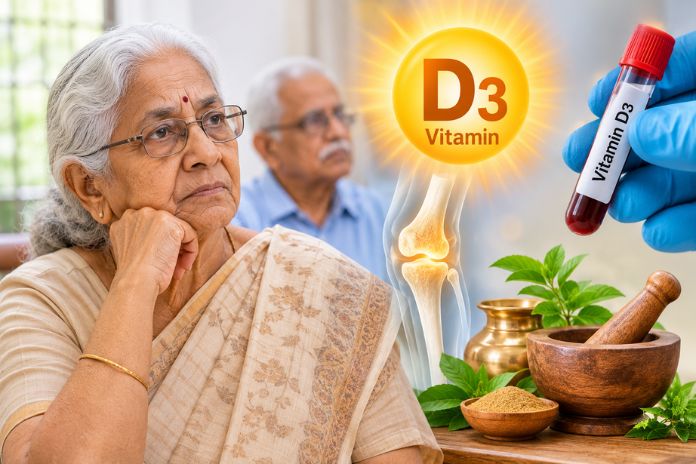
An Ayurvedic perspective on diet, lifestyle and healthy ageing: Vitamin D deficiency in older adults
Vitamin D plays a key role in the absorption of calcium, healthy bones and normal muscle function. Older adults are also at risk for low vitamin D levels due to age-related changes, limited exposure to sunlight, dietary patterns and certain health conditions.
In 2020, the Indian Journal of Applied Research published a study titled, “Study of Vitamin D3 Deficiency in Geriatrics with Ayurvedic Perspective” in which vitamin D deficiency was observed in 30 individuals above the age of 60 years. Along with measuring serum vitamin D, the researchers used concepts from Ayurveda to look at dietary, lifestyle and psychological factors.
The study presents an interesting example of how a modern laboratory measurement can be thought of together with Ayurvedic assessments. However, the results are exploratory and should not be interpreted as evidence for an effect of certain dietary habits or Ayurvedic factors on vitamin D deficiency, due to the small sample size and retrospective observational design.
The importance of vitamin D for older adults
Vitamin D helps the body absorb calcium and contributes to maintaining healthy bones and muscles. Vitamin D deficiency can cause poor bone mineralisation and in more severe or prolonged cases conditions such as osteomalacia.
There are several reasons older adults may be at higher risk for low vitamin D, including:
- Little exposure to the sun
- With increasing age, the skin produces less vitamin D.
- Poor nutrition.
- Certain disorders of the gastrointestinal tract, liver or kidneys.
- Other personal health and lifestyle factors.
The study says that vitamin D3, or cholecalciferol, can be obtained from some foods and supplements, and produced in the skin following exposure to ultraviolet radiation.
About the study: What did researchers investigate?
The study was conducted in College of Ayurved and Hospital, Bharati Vidyapeeth (Deemed to be University), Dhankawadi, Pune.
The study was undertaken to study vitamin D3 deficiency in older adults and explore its possible Ayurvedic interpretation, especially dietary, lifestyle and psychological factors (Aaharaj, Viharaj and Manas Hetu) and the involvement of Dosha, Dhatu and Srotas.
Study design: Retrospective, observational study.
Subjects: 30 subjects over 60 years of age with serum vitamin D levels <20 ng/ml.
Diagnostic work-up: Clinical symptoms and serum 25-hydroxyvitamin D [25(OH)D] measurement.
Researchers recorded details such as age, occupation, diet, sleep, lifestyle, symptoms and Ayurvedic assessment parameters of the participants.
Crucially, it was an observational study. It did not evaluate whether an Ayurvedic intervention would increase vitamin D levels or improve clinical outcomes.
What did the investigators discover?
The study was done on 30 participants and the paper discussed various patterns.
Age and profession
- 40% of the participants were between 60 and 65 years old.
- 40% were aged between 65 and 70 years.
- 20 per cent were aged over 70.
- The largest occupational group in the occupation table were housewives (43%), followed by farmers (37%), shop workers (17%) and watchmen (3%).
These numbers are representative of the subjects in this particular group and do not indicate that these age groups or occupations are at higher risk of vitamin D deficiency in the general population.
Diet and lifestyle observations
The researchers identified the following patterns:
| Factor recorded | Percentage of participants |
|---|---|
| Katu Rasa consumption | 73.33 % |
| Consumption of Tikta Rasa | 63.33% |
| Kashaya Rasa intake | 66.67% |
| Vegetarian diet | 73.33 % |
| Irregular meal times | 63.33% |
| Reported exertion | 53,33% |
| Sedentary work | 30% |
| Sleep disorders | 60% |
| Recorded category of sun exposure | 10% |
The paper also reported consumption of Makushta (Mataki) and Chana was recorded in 76.67% of participants each. These are not evidence that these foods cause vitamin D deficiency, but rather descriptive observations from the study.
Participant-reported symptoms
Several musculoskeletal and other symptoms were observed:
- Snayu Shool (pain involving tendons or associated structures) 80%
- Sandhi Shool (joint pain): 76.67%.
- Prushta Shool (back pain) : 70 %
- Anidra (restless sleep or insomnia) : 66.67%
- Asthi Shool (bone pain): 63.33 per cent.
- Khalitya (loss of hair): 60%.
Many things can cause symptoms like these, especially in older adults. They cannot confirm vitamin D deficiency on their own; laboratory testing and clinical evaluation are important.
The study measured vitamin D levels
The paper classified participants based on their measured vitamin D3 levels:
| Category used by writers | Participants No. of |
|---|---|
| Severe: 5–10 ng/ml | 7 |
| Moderate: 10 to 15 ng/ml | 12 |
| Mild: 11 15-20 ng/ml | 11 |
All 30 participants were chosen because they had vitamin D levels less than 20 ng/ml. The paper gives a percentage for the severe category that does not appear to be consistent with the number: 7 out of 30 is 23.33%, not 26.66%.
Global Journals
Discussion of the Results in the Setting of Ayurveda:
An important aspect of this research is that it attempts to interpret the observations in the light of Ayurvedic concepts.
Aaharaj Hetu: Factors of Food
The authors looked at dietary patterns such as reported intake of Katu (pungent), Tikta (bitter) and Kashaya (astringent) Rasa, irregular timings of meals and certain food combinations.
In the Ayurvedic paradigm, overconsumption of these tastes is discussed in relation to Vata Dosha aggravation and Dhatu Kshaya (depletion or diminution of bodily tissues).
The paper also discusses Viruddha Aahara or incompatible food combinations and Mandagni which is a concept related to diminished digestive capacity.
Here are the authors’ Ayurvedic interpretations. The study did not experimentally show that these dietary patterns change vitamin D metabolism or cause deficiency.
Viharaj Hetu: Factors of lifestyle
The authors considered factors such as exertion, sedentary activity, disturbed sleep and limited exposure to sunlight.
In Ayurveda, one can look at lifestyle patterns in terms of Vata and Kapha Dosha. The paper correlated some observations to Vata Prakopa and changes in Kapha.
The relevance of limited exposure to sunlight to modern nutrition is that the skin produces vitamin D after exposure to ultraviolet B radiation . As you age, your skin also loses some of its ability to produce Vitamin D.
Fact Sheet for Health Professionals
Manas Hetu: Mental factors
Shoka (grief), Chinta (worry), Krodha (anger) and Bhaya (fear) were recorded in the study. 46.67% of the participants reported Shoka and Chinta.
Authors have correlated these factors with Vata Dosha and Manovaha Srotas.
Psychological wellbeing is an important component of healthy ageing. However, this study does not draw a direct biological connection between these psychological observations and low serum vitamin D.
Observations on Dosha, Dhatu and Srotas:
Researchers found that 56.66% of the participants had predominance of Vata Dosha. They also spoke about modifications in Asthi Dhatu, Majja Dhatu and other Dhatus besides Srotas related observations.
The Ayurvedic interpretation was mainly focused on manifestations of Vata and Sandhigata Vata which was the most commonly recorded Vyadhivinichaya in the study.
This is an example of how the authors applied Ayurvedic diagnostic concepts to a group of older patients with low vitamin D measures. This is not to be taken as establishing equivalence between Ayurvedic categories and modern biochemical mechanisms.
What does modern nutritional science add to this?
The objective diagnostic measure of the study was serum 25-hydroxyvitamin D [25(OH)D]. It is the main blood marker used to determine vitamin D status.
Vitamin D helps with the absorption of calcium and bone mineralisation. It also helps support normal muscle function, so adequate vitamin D status is also relevant to maintaining mobility and bone health as people age.
Health Professional Fact Sheet +1
Vitamin D comes from a combination of skin production from sun exposure, foods, and supplements. Dietary sources that occur naturally include fatty fish, fish liver oils, egg yolks and some other animal foods. Some foods are enriched with vitamin D, depending on the product and the country.
Fact Sheet for Health Professionals:
One important qualification is how the results of blood tests are interpreted. In the study, values below 20 ng/ml were defined as deficient. However, health authorities and professional organisations do not always use the same thresholds. For example, the US National Institutes of Health Office of Dietary Supplements summarises the National Academies guidance as finding levels below 12 ng/ml to be deficiency, 12 to below 20 ng/ml as possibly inadequate and 20 ng/ml or above as sufficient for most people. The reference categories should not be considered equivalent to the grading system in the study.
Health Care Professional Fact Sheet
Practical implications for ageing well:
Although this small study is not a treatment protocol, it does highlight some areas that may be worth discussing with healthcare professionals.
- Monitor the diet: Make sure there are adequate sources of vitamin D and calcium in the diet. Older adults on vegetarian diets may want to consider fortified foods and overall diet.
- Keep safe outdoor activity : Safe outdoor activity can help to maintain mobility and provide opportunities for exposure to sunlight. Sun exposure should be balanced with protection from excessive UV radiation.
- Promote healthy ageing: Age-appropriate physical activity, including weight-bearing and balance exercises, can help to support muscle and bone health.
- Get medical evaluation when appropriate Persistent bone pain, muscle weakness, recurrent falls or other concerning symptoms need clinical evaluation. A healthcare professional can determine whether testing for 25(OH)D is appropriate.
- Use supplements responsibly: Vitamin D supplementation may be appropriate in some circumstances but dose and duration should be guided by a qualified health care professional . Too much supplementation may do harm.
Ayurvedic dietary and lifestyle practices may be incorporated into an individual’s overall wellbeing plan but should not replace laboratory assessment or medically necessary treatment for vitamin D deficiency.
Limitations: What to watch out for?
The study is useful as an exploratory report of ayurvedic observations among elderly with low vitamin D levels . However, there are several limitations that impact the interpretation of its findings:
- Small sample: The sample consisted of only 30 participants.
- Retrospective observational design: observations were recorded, rather than testing a planned intervention.
- Single center study: The study was done in a single institution in Pune which may limit the generalisability of the results.
- No comparison group: The study does not compare older adults with low vitamin D to older adults with adequate levels of vitamin D.
- Lack of evidence for causality: Associations between diet, lifestyle, psychological factors and Ayurvedic classifications do not establish the causes of vitamin D deficiency.
- No treatment outcomes: The study did not assess whether Ayurvedic treatment, dietary changes or supplementation improved vitamin D levels or symptoms.
There are also some differences in the reporting. For instance, the table on occupation lists 43% housewives while the discussion states 50% . For severe vitamin D we report 7 participants but the percentage does not add up to that number. These discrepancies should be verified with original study records before the figures are reused in further research.
Conclusion: A Dialogue between Ayurvedic Observations and Nutritional Science
The study of 2020 from Bharati Vidyapeeth, Pune, is an exploratory account of vitamin D deficiency in 30 elderly subjects, where serum 25(OH)D levels were correlated with the Ayurvedic assessment of their diet, lifestyle, psychological factors, Dosha, Dhatu and Srotas.
The observations emphasise the importance of nutrition, sunlight exposure, sleep, physical activity, and general well-being in the care of the elderly. But the small retrospective design does not prove that the Ayurvedic factors reported are the cause of vitamin D deficiency or that any specific Ayurvedic intervention can correct it.
The opportunity for Ayurveda and modern healthcare is in well designed studies that combine sound nutritional assessment, validated laboratory measurements and clearly defined clinical outcomes. Research like this can help to build a more rigorous evidence base for integrative approaches to healthy ageing .
SOURCE LINK: Study of Vitamin D3 Deficiency in Geriatrics with Ayurvedic Perspective – Indian Journal of Applied Research



